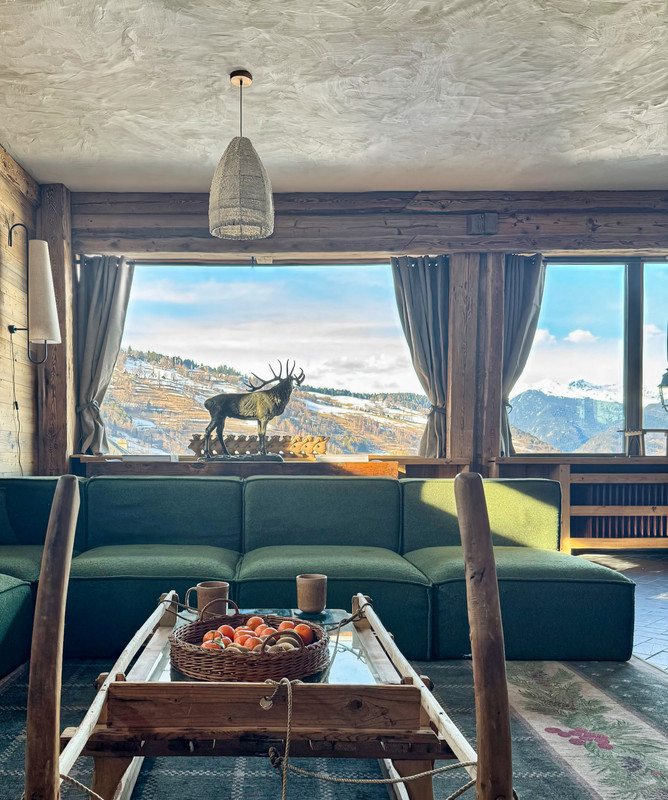
When I welcome families, I’m often asked how the hot tub “works.” The question always comes in the same tone: the one you use when you hope there’s a button somewhere, or a laminated set of instructions on the door. I always give the same answer: “There’s no button. There are three moments.”
It’s not an evasive answer. It is, quite literally, the protocol. A wood-fired hot tub isn’t something you use. It’s something you pass through, at three distinct moments of the day — and it’s the sequence of those moments, far more than the time in the hot water, that makes the ritual.
First moment · 5pmLight.
The first step of the ritual is a choice. At 5pm, you have to decide that you want to get in at 7pm. Two hours of waiting feels long when you come from a world that heats up in ten minutes. But that wait holds everything else.
In practice: someone goes down to the terrace. Someone opens the small hatch of the built-in stove. Someone stacks three birch logs in a teepee and lights them from below with a sheet of newspaper. Someone leaves the door open for ten minutes while it catches.
In the families I welcome, that someone changes every evening. On the first day, it’s often the father who takes it on, out of habit. On the second, a teenager claims the fire like territory. On the third, it’s the aunt who had never lit a stove in her life and finds it, and I quote, “more interesting than a yoga class.” On the fourth, sometimes, no one does — so dinner happens indoors, and that’s fine.
Lighting a fire for eight people is a way to be useful without doing the dishes. — A grandmother, January 2026
Between 5pm and 7pm, you need to go back to the fire every twenty minutes. Nothing special: add a log, close the door, check the thermometer. These repeated trips out to the terrace, between the warmth of the living room and the cold air outside, are the ritual’s second purpose. They make you step outside three times. They make you look up at the sky three times. They remind you that you’re at an altitude of 1,450 meters and that winter is real. Nobody does that on purpose when there’s no reason to.
Second moment · 7pmPlunge.
In Valmorel in winter, going from the open air into 104°F water takes two seconds. It’s a kind shock. Your whole body remembers it has skin.
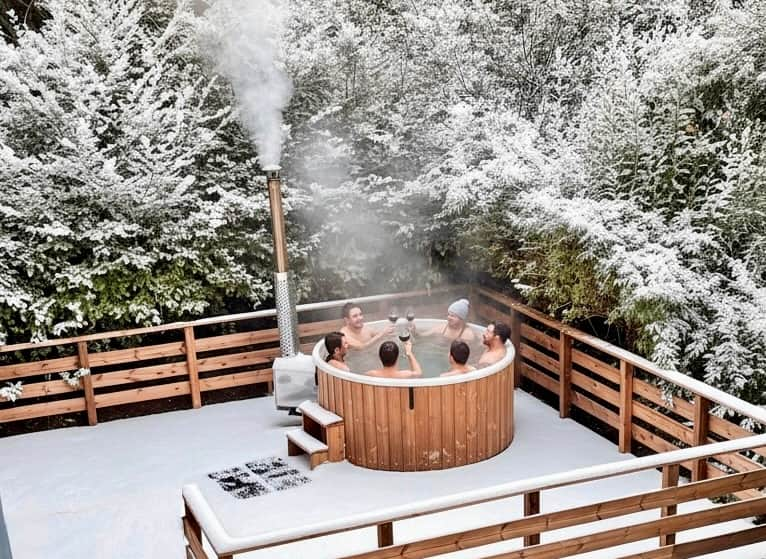
My advice, always: never get into the tub all at once. Go in waves of two or three, five minutes apart. Whoever arrives last always finds the best spot — the one by the edge, with a view of the peaks. And there’s something different about a conversation among three, then five, then eight. The intensity rises with the numbers. At eight, it’s a different kind of talk.
I mean the glass you brought in with you. Mulled wine, or a local beer (we have Brasseurs Savoyards delivered to the chalet bar), or sparkling water for those who’d rather stay sober. That first glass goes on the cedar rim, your hands back in the water, and you look at it for ten minutes without touching it. It’s almost involuntary. The heat first leaves you in a kind of daze that keeps you from drinking. You talk, you laugh, you fall quiet, you watch the sky darken. The glass waits. You raise it to your lips after ten or fifteen minutes, and it’s already a little cold. That’s perfect.
Third moment · 8:30pmTalk.
In every hot tub evening, there’s a moment when the conversation tips over.
It isn’t gradual. It’s sharp, clear, you could put a time on it. At first you talk about the day: the slopes, the snow, the crowd at the chairlift, the cousin’s fall. Surface topics, safe ones. Forty minutes later — it takes that long — someone says something nobody planned. A confession, a memory, a reflection. The conversation shifts. People start talking about what they don’t usually say, and the others follow.
It took me two years to understand why. My theory, today: the hot water relaxes you, but the starry sky strips away the social. When you look up and see the constellations straight overhead, something in the protocol of normal conversation comes apart. You feel smaller. You feel less important. And when you feel less important, you dare to say what you never thought you would.
For connoisseursWhat we haven’t told you yet.
The hot tub works in the morning, too. After three days, many tribes discover they can wake the embers very early and get into the water at 8am, facing the sun as it rises over the Lauzière. It’s another ritual, less social, more contemplative. It suits the insomniacs in the group, the parents who need twenty minutes of silence before the kids wake up, and couples in love.
It works in summer, too. The water, heated to 90 or 95°F, becomes a giant thermal bath. The alchemy changes: you’re no longer coming in from the snow, you’re getting into the water after a hike. But the three-moment structure stays the same. Light, plunge, talk.
It doesn’t work when the group has collectively decided to stay on their phones. I’ve seen it twice in three years. It’s a rare mistake, but a spectacular one: the fire heats for nothing, the water reaches 104°F, no one comes down, or those who do scroll Instagram in the water. The conversation never tips over. Under those conditions, the hot tub is just a jacuzzi. It’s not the same thing.
The secret ruleThe one I don’t tell families.
Here’s the rule we don’t mention when we welcome you, because it would sound too solemn: in the hot tub, nobody talks about work.
No contracts. No colleagues. No ongoing projects. No reports due on Monday. No due dates, no deadlines, no careers.
It isn’t written on the door. No one enforces it. But when you’re in hot water at 104°F, under the stars, with your tribe, talking about work becomes literally impossible. The body knows it before the head understands it. Every time a guest has tried to bring up a work topic in the tub, the conversation folded within three sentences.
Maybe that’s it, in the end: the real reason we heat with wood. Not for authenticity. Not for the environment. For the intelligence of the body — give it two hours, and it knows what to forget.
Light, plunge, talk. Three moments. Try them in order, and write to me afterward to tell me what you thought.