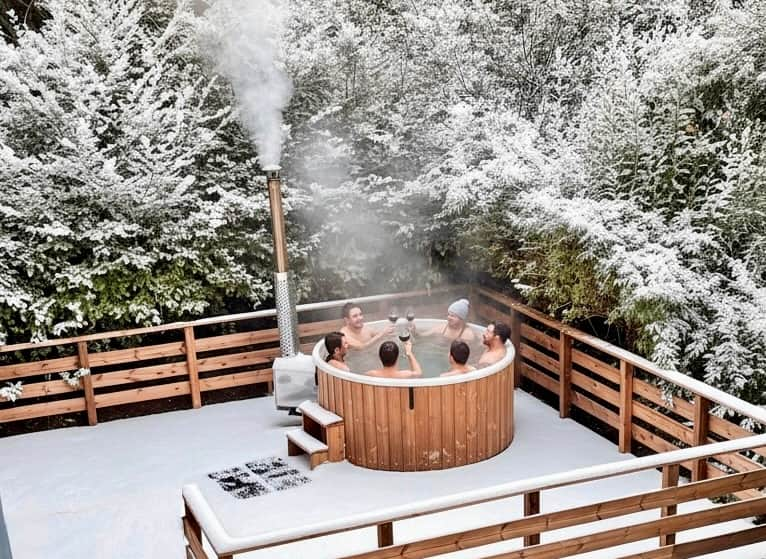
Two years ago, we faced what looked like a simple choice. The company that delivered hot tubs in Savoie offered us two models: the same cedar design, the same 2,500 liters, the same deck waiting for it. On one side, an electric heater: press a button in the morning, soak in the evening. On the other, a built-in wood-fired stove: light it at 5pm, plunge in at 7pm, watch the smoke, bring in the logs. The electric one was cheaper. Simpler. More modern. It is the one new owners are usually advised to buy.
We chose the wood fire. That was two years ago. Today, I believe it is the best decision we have made for Arpian — and I am not sure we made it for the right reasons.
01. The official reasonThe line we gave our friends.
When people asked, we would answer: “It’s greener.” Which is, technically, debatable. Burning wood, even local wood, emits CO₂ and fine particles. French electricity, mostly nuclear, is among the lowest-carbon in Europe. On an Excel spreadsheet, the electric heater wins.
We would go on: “It’s more authentic.” A word I hate, because it means nothing. Every wood stove was invented by engineers. Ours comes from a small Finnish factory, made the trip by truck from Helsinki, and had never seen an alp in its life before arriving in Les Avanchers. Authentic is the word you use when you don’t want to say the real reason.
We understood the real reason after the fact. And it was so much more interesting than the first two that we finally dared to say it out loud.
We chose fire because it would force us to slow down. — Guillaume, Arpian co-host
02. The protocolWhat happens between 5pm and 7pm.
Here is how it works, in practice. Someone comes back from the slopes around 4:30pm. We tell them: “If you want a soak tonight, you have to light it now.” That sentence, logistical on the surface, is really a small philosophical program. It assumes you have decided, three hours ahead, what you will want from your evening. It assumes you are willing to put your hands on the logs instead of putting them straight around a glass of mulled wine.
After that, it is very precise. Three birch logs go in — birch catches faster than spruce. Light it from the bottom. Leave the door open for ten minutes so it draws. Add two oak logs once the flames are established — oak holds the temperature. Close the door. Come back every twenty minutes.
After an hour, the water is at 82°F. It takes another forty minutes to reach 104°F. During those forty minutes, something happens that I had not anticipated.
03. What we had not anticipatedThe pre-ritual.
At first, we thought the hot tub was about soaking. That is, the hour spent in hot water, facing the peaks, glass in hand. We told ourselves: we build the fire because we have to, but what matters is the moment after.
We were wrong. What matters is the moment before.
The wait is twenty minutes of watching the fire while doing nothing in particular. Just checking that it draws. Adding a log. Taking a step back. Talking a little. That is often when people say things they would never say at a restaurant. That is when the teenager who sulked all day starts talking, unprompted, about the boy who ignores her at school. That is when two friends who have not seen each other in five years drop the small talk and speak about something else. The fire is a wonderful pretext. It keeps the hands just busy enough for the conversation to unfold.
An electric heater asks nothing of you. It heats while you look at your phone. It heats while everyone, in their own corner, winds down the day in parallel with the others. And when the beep sounds, you go for a soak the way you would go take a shower. It is efficient. It is not a ritual.
04. The price of slownessWhat we gave up, and why it was right.
I won’t pretend. There are evenings when we pay for choosing the wood fire.
There are evenings when the tribe comes back exhausted at 5:30pm and nobody feels like lighting anything. There are stormy evenings when the smoke blows back down and we shut everything, promising ourselves to try again tomorrow. There are weekends when we end up soaking at 10:30pm, a little too late, a little too tired, wondering whether we would have been better off pressing a button.
And then there are all the other evenings.
All the other evenings when the fire marked a beginning. A clear line between the ski day and the evening at the chalet. A transition that does not exist when everything is instant. The families who leave Arpian rarely write to tell us the water was the right temperature. They write to say: “The conversation we had around the stove, I think it saved next summer.” And it is always the same words, give or take.
05. What the fire taught usAbout Arpian, about ourselves.
In three years, we have understood something that goes beyond the hot tub. Every decision we made for the chalet that worked points in the same direction: it adds a little friction, a little waiting, a little gesture. Fire instead of electricity. Beds made by hand rather than disposable covers. The wooden bar we had Samuel restore rather than replace. Restaurant recommendations given in person, in the evening, rather than through a QR code on the table.
It is the same idea, in different forms. Luxury, to us, is not what we do for you. It is the time we leave you to do things yourselves.
The electric heater is what we would have prescribed for a hotel. A place people pass through, where everything has to be optimized, where you cannot ask a traveler to plan their evening three hours ahead. It is a very good object, for what it does.
The fire, we chose for what it requires us to be. And we chose it for what it offers you, those of you who come: not a product, not a service, but a presence — for one evening — with something that takes its time.
That is why, if you come to Arpian, we will always tell you the same thing around 4:30pm: “If you want a soak tonight, you have to light it now.” It sounds like we are talking logistics. In fact, we are making you an offer.
